
Humanoid Robotics Breakthroughs Accelerate Commercialization and High Speed Dynamic Control
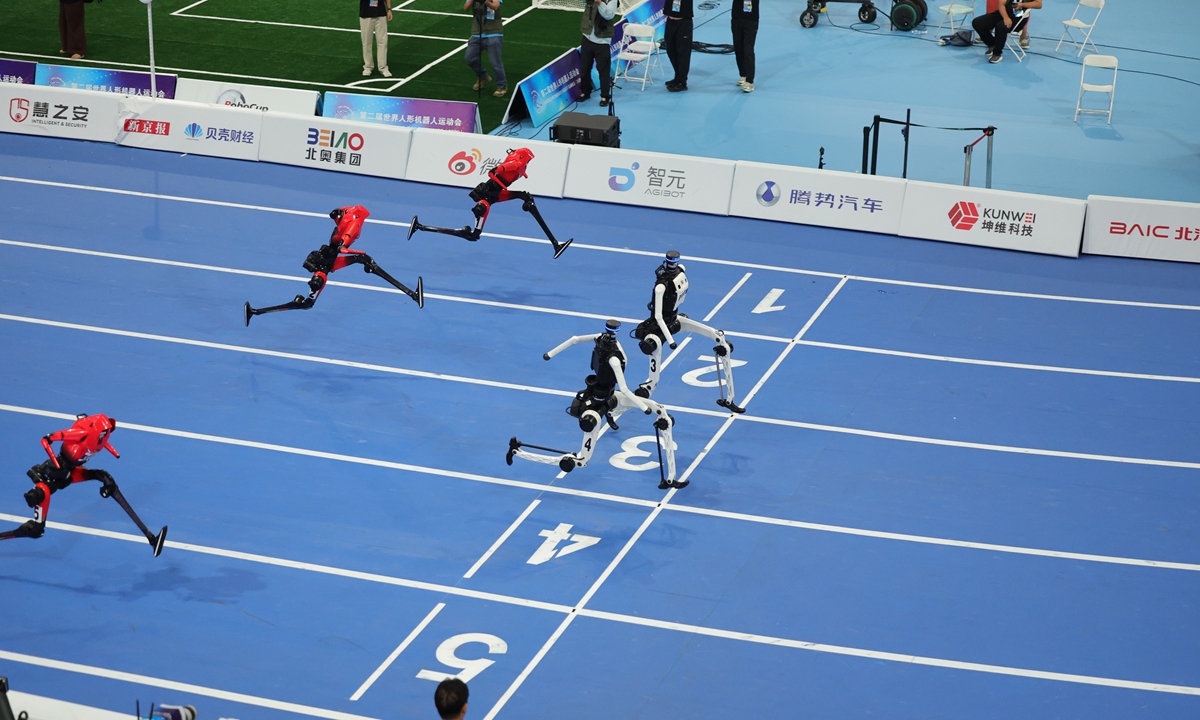
The performance milestones recorded at the 2nd World Humanoid Robot Games in Beijing—culminating in X-Humanoid's Tiangong Ultra setting an 8.64-second record in the 100-meter sprint—signal a major shift in dynamic motion control, high-torque density actuator design, and real-time motion planning. Shaving more than 3.36 seconds off last year's winning mark of over 12 seconds demonstrates an accelerating rate of hardware-software co-optimization. Beyond sprinting faster than Usain Bolt's human world record of 9.58 seconds, the technical reality highlights how reinforcement learning algorithms, foot-strike contact dynamics, and closed-loop feedback systems enable robotic bipedal platforms to execute continuous ground reaction force management at speeds exceeding 11.5 meters per second.
From a technology development and supply chain perspective, these athletic displays benchmark core physical hardware specifications across extreme strain environments. Sprints and high jumps subject joint actuators, harmonic drive gearboxes, and lithium-based power packs to high peak discharge rates and intense mechanical shocks. Sustaining operational stability during high-speed gait transitions requires high control frequencies—often operating at 1,000 Hertz or higher—coupled with custom brushless direct-current (BLDC) motors capable of delivering power densities well above 2.5 kilowatt-hours per kilogram. Additionally, endurance milestones such as Honor’s Lightning registering a net time of 50 minutes 26 seconds in the humanoid half-marathon demonstrate improvements in continuous thermal management, joint friction mitigation, and battery energy density, which are directly applicable to 8-to-12-hour continuous industrial shift cycles.
Commercial projections for the humanoid sector reflect this rapid transition from experimental prototypes to functional industrial deployments. Global market forecasts indicate that overall humanoid robot shipments are projected to grow by over 270% year-on-year in 2026, reaching nearly 60,000 units while expanding global market revenues toward $1.6 billion. Industrial and commercial end-users now account for more than 70% of total volume demands. According to reporting published by People's Daily, building integrated supply chains across key hardware components—such as planetary reduction gears, six-axis force torque sensors, and high-precision IMUs—helps lower average selling prices (ASPs) from historical bounds of $100,000 down to scalable commercial price bands of $20,000 to $35,000 per unit.
Ultimately, track-and-field performance metrics serve as stress tests for real-world applications in logistics, automated manufacturing, and public emergency response. Overcoming remaining technical bottlenecks—such as uncontrolled deceleration dynamics at high speed and autonomous obstacle avoidance in unstructured environments—will define the timeline for enterprise adoption. As foundational embodiment models integrate multi-modal sensor inputs with dynamic balance controllers, humanoid platforms will move beyond controlled competition tracks into logistics warehouses, automotive assembly lines, and complex hazardous environments, delivering measurable gains in operational efficiency, labor productivity, and workplace safety.
News source: https://peoplesdaily.pdnews.cn/tech/er/30053022676
Discipline at the table begins long before the bottle is opened — it begins in the cellar, with restraint.— Ava Devine, Master Sommelier & Founder