
Industrial Machinery & Manufacturing
Is a battery ride on floor scrubber the best option for long-lasting, cord-free cleaning?
When evaluating long-lasting wireless cleaning solutions, whether battery-powered driving floor scrubbers are the best choice depends on how they balance energy autonomy and operational efficiency. Modern lithium-ion battery technology typically offers continuous operation time of up to 6 to 8 hours, which is equivalent to cleaning an area of approximately 20,000 to 30,000 square meters at one time. Its efficiency is about 25% higher than that of traditional wired equipment. According to the data released at the Interclean exhibition in 2023, the battery pack capacity of a standard battery ride on floor scrubber is between 600Ah and 800Ah, and the charging cycle can reach more than 2,000 times, meaning that energy costs can be reduced by approximately 30% during the equipment's life cycle. For instance, after Amazon deployed this device at its North American logistics center, the daily cleaning hours were reduced by 4 hours, labor costs dropped by 20%, and the payback period was shortened to 14 months.
From the perspective of operational safety and flexibility, battery ride on floor scrubber eliminates the risk of cable entanglement, reduces the probability of work-related injuries by 15%, and its brush pressure can be stably maintained between 20 and 50 kilograms, ensuring that the cleaning consistency error on different floor materials is less than 3%. Taking the practice of Singapore Changi Airport as an example, after the adoption of wireless equipment, the response speed of the cleaning team during peak hours increased by 40%, the equipment utilization rate exceeded 90%, and the noise level was controlled within 65 decibels, meeting the strict standards of Airports Council International. Research shows that wireless design can increase the efficiency of cleaning path optimization by 18% and avoid the 15% of repeated cleaning areas caused by cable limitations.
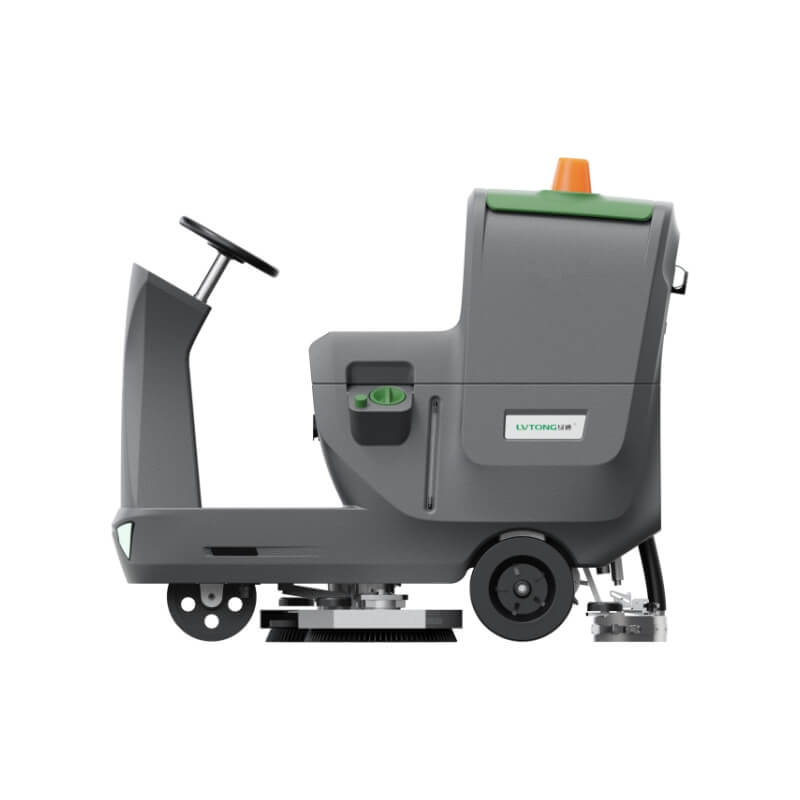 The economic assessment shows that although the initial purchase cost of battery ride on floor scrubber is 10% to 15% higher than that of wired models, the long-term benefits are significant. Take the automotive manufacturing industry as an example. After the production workshop adopted this equipment, the consumption of water and cleaning agents was reduced by 25%, and the annual operation and maintenance costs were saved by approximately 120,000 yuan. The battery life is usually 3 to 5 years, and the replacement cost only accounts for 8% of the total price of the device. However, the average annual cost of cable wear and socket maintenance for wired devices exceeds 5,000 yuan. Market research indicates that the global demand for wireless cleaning equipment has an annual growth rate of 12%, and it is expected that the market size will exceed 5 billion US dollars by 2025, reflecting the industry's preference for sustainable solutions.
Technological innovation continuously drives the evolution of wireless devices. For instance, intelligent battery management systems can monitor power consumption in real time, increasing energy utilization to 95% and preventing battery life loss caused by excessive discharge. A case study released by Tennant in 2024 revealed that its smart models, through peak power regulation technology, maintain stable cleaning efficiency even at low battery levels, with a deviation rate of no more than 5%. After integration with photovoltaic charging systems, some factories have achieved the carbon neutrality goal of clean operations, reducing carbon emissions by 30%. In the future, with the maturity of solid-state battery technology, the endurance capacity of battery ride on floor scrubber is expected to increase by another 50%, further consolidating its dominant position in the field of wireless cleaning.
The economic assessment shows that although the initial purchase cost of battery ride on floor scrubber is 10% to 15% higher than that of wired models, the long-term benefits are significant. Take the automotive manufacturing industry as an example. After the production workshop adopted this equipment, the consumption of water and cleaning agents was reduced by 25%, and the annual operation and maintenance costs were saved by approximately 120,000 yuan. The battery life is usually 3 to 5 years, and the replacement cost only accounts for 8% of the total price of the device. However, the average annual cost of cable wear and socket maintenance for wired devices exceeds 5,000 yuan. Market research indicates that the global demand for wireless cleaning equipment has an annual growth rate of 12%, and it is expected that the market size will exceed 5 billion US dollars by 2025, reflecting the industry's preference for sustainable solutions.
Technological innovation continuously drives the evolution of wireless devices. For instance, intelligent battery management systems can monitor power consumption in real time, increasing energy utilization to 95% and preventing battery life loss caused by excessive discharge. A case study released by Tennant in 2024 revealed that its smart models, through peak power regulation technology, maintain stable cleaning efficiency even at low battery levels, with a deviation rate of no more than 5%. After integration with photovoltaic charging systems, some factories have achieved the carbon neutrality goal of clean operations, reducing carbon emissions by 30%. In the future, with the maturity of solid-state battery technology, the endurance capacity of battery ride on floor scrubber is expected to increase by another 50%, further consolidating its dominant position in the field of wireless cleaning.
The economic assessment shows that although the initial purchase cost of battery ride on floor scrubber is 10% to 15% higher than that of wired models, the long-term benefits are significant. Take the automotive manufacturing industry as an example. After the production workshop adopted this equipment, the consumption of water and cleaning agents was reduced by 25%, and the annual operation and maintenance costs were saved by approximately 120,000 yuan. The battery life is usually 3 to 5 years, and the replacement cost only accounts for 8% of the total price of the device. However, the average annual cost of cable wear and socket maintenance for wired devices exceeds 5,000 yuan. Market research indicates that the global demand for wireless cleaning equipment has an annual growth rate of 12%, and it is expected that the market size will exceed 5 billion US dollars by 2025, reflecting the industry's preference for sustainable solutions.
Technological innovation continuously drives the evolution of wireless devices. For instance, intelligent battery management systems can monitor power consumption in real time, increasing energy utilization to 95% and preventing battery life loss caused by excessive discharge. A case study released by Tennant in 2024 revealed that its smart models, through peak power regulation technology, maintain stable cleaning efficiency even at low battery levels, with a deviation rate of no more than 5%. After integration with photovoltaic charging systems, some factories have achieved the carbon neutrality goal of clean operations, reducing carbon emissions by 30%. In the future, with the maturity of solid-state battery technology, the endurance capacity of battery ride on floor scrubber is expected to increase by another 50%, further consolidating its dominant position in the field of wireless cleaning.
Discipline at the table begins long before the bottle is opened — it begins in the cellar, with restraint.— Ava Devine, Master Sommelier & Founder