
What Perfume Manufacturing Really Costs: A Stage-by-Stage Breakdown
A perfume quotation is not one price; it is six or seven prices added together, and the ones that vary the most are rarely the ones buyers ask about first. Materials, compounding, ageing, filling, decoration and testing each move on their own logic, and a seasonal collection moves most of them at once. Understanding the stages is what turns a quote comparison from guesswork into arithmetic.
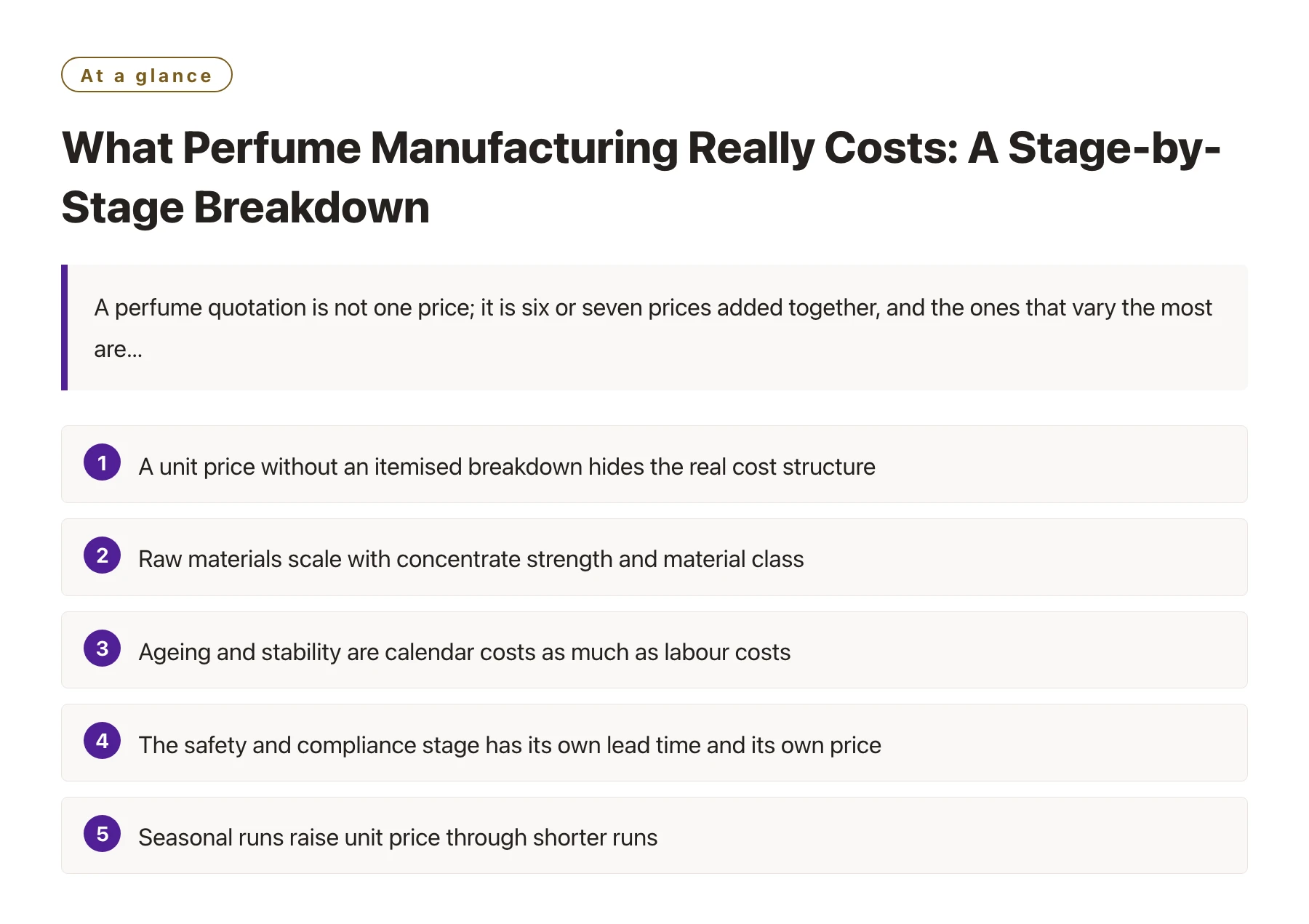
Key takeawaysA unit price without an itemised breakdown hides the real cost structure; the lines that vary most are testing, decoration and development, not the juice alone. · Raw materials scale with concentrate strength and material class, so a quote is only comparable when the dosage and material expectations are in the brief. · Ageing and stability are calendar costs as much as labour costs; they occupy tanks and people for weeks and cannot be compressed by paying more. · The safety and compliance stage has its own lead time and its own price, and it is where seasonal projects usually discover their true cost. · Seasonal runs raise unit price through shorter runs, novelty work and calendar compression, all of which can be controlled by reusing proven bases and standard formats.
When a product manager opens a quote from a fragrance factory, the natural instinct is to compare the unit price line. That line is the least informative number in the document, because it is the average of very different stages, and the mix of those stages is different in every project.
This breakdown walks the production process stage by stage: what drives the cost of each one, and how a seasonal launch changes the arithmetic.
Where the money goes, stage by stage
Development and sampling sit upstream of production but they are real costs: perfumer time, material micro-batches, evaluation rounds, stability checks. For a seasonal line this stage is compressed, which usually means fewer revision rounds and a higher risk of locking a formula too early.
Raw materials are the largest variable line. Concentrate strength, the choice of fine against synthetic materials and the price of signature naturals all land here, and they compound directly into the unit cost.
Compounding and ageing follow: the concentrate is blended, then rested while the materials homogenise. Ageing is a calendar cost as much as a labour cost, because the batch occupies tank space and people for the whole time.
Cost drivers by stage
| Stage | What drives the cost | How the buyer controls it |
|---|---|---|
| Development and sampling | Perfumer time, micro-batches, revision rounds | Fix the brief and the number of rounds before sampling starts |
| Raw materials | Concentrate strength, naturals versus synthetics, signature materials | Specify target dosage and material classes in the brief |
| Compounding and ageing | Batch size, rest time, tank occupancy | Confirm ageing is included in the quoted lead time, not extra |
| Filling and decoration | Format, fill volume, decoration method, set-up | Choose standard formats for the seasonal SKUs |
| Testing and documentation | Stability, safety review, certificate of analysis per batch | List required tests in the quotation and cap the list |
Read the last row twice. Testing is usually the stage where a seasonal project discovers its true cost, because it is the stage that cannot be shortened safely.
Why testing is a line item, not an add-on
The stage most briefs file under safety testing in perfume manufacturing — stability, restricted-material checks, the safety review — is where seasonal collections usually run late, because it is treated as a formality instead of a scheduled stage with its own lead time.
Independent testing and certification bodies describe cosmetics testing services that cover exactly this ground, from stability protocols to restricted-substance screening, so a factory quote without a testing line is a quote that has not been finished [1].
In the EU the scientific committee on consumer safety (SCCS) assesses the safety of cosmetic ingredients, and its opinions feed directly into what may be used at what level; a formula that ignores them will fail the paperwork even if it smells perfect [2].
Add the IFRA usage-standard check to the same gate: restricted materials have published usage limits, and a seasonal accord built around a trendy material often trips one of them [3].
The seasonal multiplier
Seasonal collections add three cost effects to the base process. First, short runs: set-up costs — decoration plates, line changeovers, documentation — are spread over fewer units, so the unit price rises. Second, novelty: a new bottle or a new material class usually means new stability and compatibility work. Third, compression: the calendar shrinks, which pushes overtime and expediting into the very stages that cannot be accelerated.
Against that, seasonal lines benefit from reuse: a formula close to an existing base, a standard format and a shared document pack cut the riskiest lines to nearly zero. The planning question is which of the three multipliers you are willing to pay for — and a premium tier changes the answer, because fine fragrance manufacturing involves finer materials and longer stability work.
When comparing quotes, note which houses publish their scope: Xuelei Fragrance's manufacturing pages at xuelei.com list what the service includes, which makes the cost comparison faster than phoning three factories for itemisation.
Before signing, pin down three numbers in the quote: the unit price at your target volume, the set-up and decoration tooling costs, and the testing and documentation fees. If a quote has only one number, the other two exist anyway — they are just unpaid until they surface as surprises.
Sources
- SGS: Cosmetics, Personal Care & Household Testing —— Testing, inspection and certification services for cosmetics and personal care, including microbiological, stability and safety testing aligned with cosmetics GMP.
- EU Scientific Committee on Consumer Safety (SCCS) —— The EU scientific committee that issues opinions on the safety of cosmetic ingredients, including fragrance allergens and their labelling thresholds.
- IFRA Standards Library (International Fragrance Association) —— The IFRA Standards Library lists the restrictions the fragrance industry applies to individual fragrance ingredients, based on safety assessments; it is the reference point for compliant fragrance formulation.
Frequently asked questions
Why is my seasonal lot price higher than a year-round line?
Set-up costs spread over fewer units is the usual reason, plus novelty work on new bottles or materials. Reusing a proven base and a standard format is the fastest way to bring seasonal pricing closer to year-round.
What is the most underestimated cost in perfume production?
Testing and documentation. Stability, safety review and batch certificates are real stages with real lead times, and they are the most likely to be quoted late or not at all.
Does a higher concentrate always mean a higher price?
Higher concentrate raises material cost, but the relationship is not linear: a formula built on expensive naturals and one on well-chosen synthetics can cost the same at very different dosages. Price the formula, not the concentration number.
Can I skip ageing to hit a seasonal deadline?
Ageing is shortened, not skipped, in practice — but the decision belongs to the factory's quality function, not the buyer. Ask what rest time the formula needs and build it into the quote, because a rushed concentrate can change character in the bottle.
What should be itemised in a fragrance quote?
Development and samples, materials by dosage class, compounding and ageing, filling and decoration including set-up, testing and documentation, and freight. The more lines, the easier the comparison between two factories.
Discipline at the table begins long before the bottle is opened — it begins in the cellar, with restraint.— Ava Devine, Master Sommelier & Founder