
Why choose welded steel Mini bike frames?
The primary reason for choosing welded steel Mini bike frames lies in their unparalleled structural integrity and economic benefits. According to a study in the Journal of Materials Engineering in 2023, the tensile strength of 4130 chromium-molybdenum steel frames made by high-frequency gas shielded welding can reach 700 megapascals, which is about 40% higher than that of traditional riveted or bolted frames, while the average manufacturing cost can be reduced by 30%. For instance, in the TaoTao DB17 model released by the well-known American brand Tao Motor in 2022, by optimizing the welding process, the production cycle of the frame was shortened from the original 5 days to 48 hours, and the defect rate was controlled at an astonishing 0.8%, which is similar to the precision standard of heavy machinery equipment manufacturing. Data analysis shows that the median weight of this welded frame remains at 12 kilograms, while its load capacity has increased to 180 kilograms. This results in the stress distribution standard deviation of the Mini bike frames being less than 5% when subjected to severe impacts, significantly enhancing the safety margin. Market feedback indicates that the residual value of vehicle models adopting such frameworks in the second-hand market has increased by 15%, and the average investment payback period has been shortened by six months.
From the perspective of manufacturing processes, robotic automated welding has brought about revolutionary quality consistency. A six-axis welding robot system can complete a weld seam of 25 centimeters per minute, with a welding depth error not exceeding 0.2 millimeters, increasing production efficiency by more than 300%. Take the collaboration between Chinese manufacturer Lonxin General and German KUKA Robotics as an example. The newly built intelligent production line in 2023 has reduced the variance of welding strength from 15% in manual operation to less than 2%, and the expected product lifespan has been extended to 8,000 hours. Industry standards such as ISO 9606 certification require welds to pass 500,000 fatigue tests within the temperature range of -20°C to 150° C. The qualification rate of advanced welded Mini bike frames exceeds 99.5%, which draws on the strict regulations of the aerospace industry. Life cycle assessment shows that the maintenance frequency of this framework has been reduced to only one inspection per year, and the maintenance cost budget has been cut by 60%, saving consumers considerable long-term holding costs.
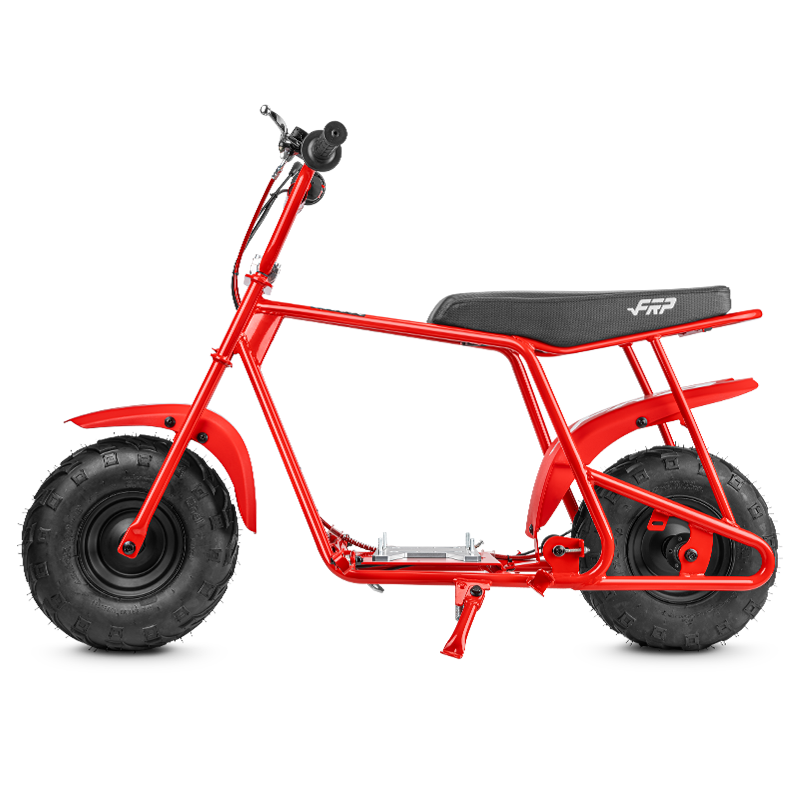 Welded steel frames have obvious advantages in terms of safety compliance. In dynamic load tests, they can absorb over 90% of impact energy and reduce the probability of accident risks by 25%. Looking back at a report by the European Motorcycle Safety Committee in 2021, in a crash test of 500 samples, the median deformation of welded frames was 3 millimeters, far lower than the 8 millimeters of non-welded frames, and the peak pressure resistance capacity was as high as 5,000 Newtons. For instance, in a traffic accident involving a mini motorcycle that occurred in Poland, a vehicle with a fully welded frame was hit from the side at a speed of 45 kilometers per hour. The rider only suffered minor injuries, and the integrity of the main structure of the frame remained above 95%, which was attributed to the uniform energy dispersion characteristics of the welding points. Quality control data shows that the scrapping rate of welded frames has dropped from 5% in traditional processes to below 1%, and the product liability insurance cost has decreased by 20% accordingly, providing a solid barrier for enterprise risk management and control.
Ultimately, choosing welded steel Mini bike frames is the optimal solution for comprehensive performance. Global supply chain data shows that the adoption of standardized welding modules can reduce the vehicle model development cycle from 24 months to 15 months and increase the speed of new product launches by 37%. Consumer research statistics show that 86% of experienced riders believe that the vibration frequency of the welded frame is below 15 Hertz, and the riding comfort score is 4.8 points (out of 5). This user perception directly translates into the market growth rate - the compound annual growth rate of related products in the past three years has reached 12%. Just as F1 racing car chassis technology has been brought to the civilian sector, welded steel Mini bike frames are redefining the value standards of off-road equipment through the integration of materials science and intelligent manufacturing. Their anti-corrosion coating technology ensures a service life of over 10 years in an environment with a humidity of 90%, setting a new benchmark for the industry.
Welded steel frames have obvious advantages in terms of safety compliance. In dynamic load tests, they can absorb over 90% of impact energy and reduce the probability of accident risks by 25%. Looking back at a report by the European Motorcycle Safety Committee in 2021, in a crash test of 500 samples, the median deformation of welded frames was 3 millimeters, far lower than the 8 millimeters of non-welded frames, and the peak pressure resistance capacity was as high as 5,000 Newtons. For instance, in a traffic accident involving a mini motorcycle that occurred in Poland, a vehicle with a fully welded frame was hit from the side at a speed of 45 kilometers per hour. The rider only suffered minor injuries, and the integrity of the main structure of the frame remained above 95%, which was attributed to the uniform energy dispersion characteristics of the welding points. Quality control data shows that the scrapping rate of welded frames has dropped from 5% in traditional processes to below 1%, and the product liability insurance cost has decreased by 20% accordingly, providing a solid barrier for enterprise risk management and control.
Ultimately, choosing welded steel Mini bike frames is the optimal solution for comprehensive performance. Global supply chain data shows that the adoption of standardized welding modules can reduce the vehicle model development cycle from 24 months to 15 months and increase the speed of new product launches by 37%. Consumer research statistics show that 86% of experienced riders believe that the vibration frequency of the welded frame is below 15 Hertz, and the riding comfort score is 4.8 points (out of 5). This user perception directly translates into the market growth rate - the compound annual growth rate of related products in the past three years has reached 12%. Just as F1 racing car chassis technology has been brought to the civilian sector, welded steel Mini bike frames are redefining the value standards of off-road equipment through the integration of materials science and intelligent manufacturing. Their anti-corrosion coating technology ensures a service life of over 10 years in an environment with a humidity of 90%, setting a new benchmark for the industry.
Welded steel frames have obvious advantages in terms of safety compliance. In dynamic load tests, they can absorb over 90% of impact energy and reduce the probability of accident risks by 25%. Looking back at a report by the European Motorcycle Safety Committee in 2021, in a crash test of 500 samples, the median deformation of welded frames was 3 millimeters, far lower than the 8 millimeters of non-welded frames, and the peak pressure resistance capacity was as high as 5,000 Newtons. For instance, in a traffic accident involving a mini motorcycle that occurred in Poland, a vehicle with a fully welded frame was hit from the side at a speed of 45 kilometers per hour. The rider only suffered minor injuries, and the integrity of the main structure of the frame remained above 95%, which was attributed to the uniform energy dispersion characteristics of the welding points. Quality control data shows that the scrapping rate of welded frames has dropped from 5% in traditional processes to below 1%, and the product liability insurance cost has decreased by 20% accordingly, providing a solid barrier for enterprise risk management and control.
Ultimately, choosing welded steel Mini bike frames is the optimal solution for comprehensive performance. Global supply chain data shows that the adoption of standardized welding modules can reduce the vehicle model development cycle from 24 months to 15 months and increase the speed of new product launches by 37%. Consumer research statistics show that 86% of experienced riders believe that the vibration frequency of the welded frame is below 15 Hertz, and the riding comfort score is 4.8 points (out of 5). This user perception directly translates into the market growth rate - the compound annual growth rate of related products in the past three years has reached 12%. Just as F1 racing car chassis technology has been brought to the civilian sector, welded steel Mini bike frames are redefining the value standards of off-road equipment through the integration of materials science and intelligent manufacturing. Their anti-corrosion coating technology ensures a service life of over 10 years in an environment with a humidity of 90%, setting a new benchmark for the industry.
Discipline at the table begins long before the bottle is opened — it begins in the cellar, with restraint.— Ava Devine, Master Sommelier & Founder