
Back From the Bench: Does a Repaired Miner Still Reach 0.01 BTC?
A repair is only finished when the machine has paid back the time it spent on the bench. At 250 TH/s the unit needs 89.2 days to produce 0.01 BTC, and a fortnight of downtime has already consumed 16% of that schedule. The question is not whether it switches on, but whether it still earns its place.
Key takeaways
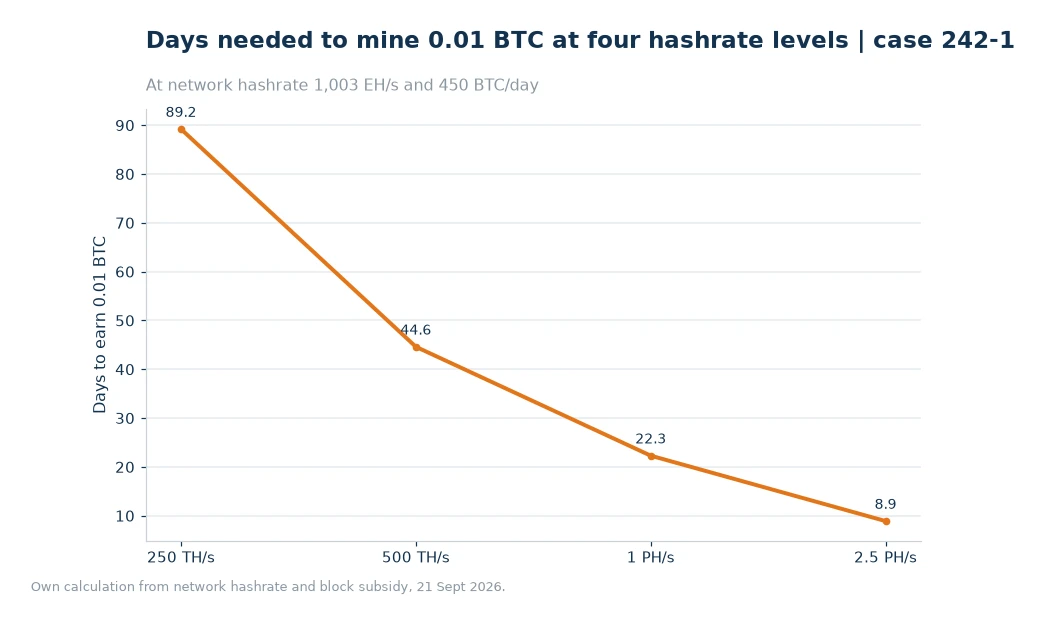
- 0.01 BTC takes 89.2 days at 250 TH/s, 44.6 at 500 TH/s and 22.3 at 1 PH/s.
- A 14-day repair pushes an 89.2-day schedule to about 103 days even if the machine returns at full speed.
- Pool Hashrate on the restart day may differ from the reading before the failure, so the old estimate needs refreshing.
- A repaired unit that draws noticeably more watts per terahash can reach the coin target and still be worth retiring.
The repair only counts if the clock restarts cleanly
Boards come back from the bench in three states. The first is fixed and indistinguishable from before. The second is fixed but slower, usually because a replacement component runs hotter or a fan curve was never restored. The third is technically alive and quietly unstable, dropping shares in a pattern that no single reading catches. Only the first state deserves the old schedule.
So the useful question after a repair is not whether the unit hashes. It is whether the unit hashes at the rate the old plan assumed, for long enough to reach the target that justified the repair. That is a measurable question, and it takes about a week to answer.
What the unit must produce after the fix
At 250 TH/s the daily credit is 0.00011216 BTC, worth $9.50 at $84,692. The 0.01 BTC target needs 89.2 days of that, or 44.6 days if the unit is a 500 TH/s model. Those figures are the benchmark the repaired machine has to meet, not a hope attached to the invoice from the repair shop.
If the repair cost two weeks and the unit returns at 3% below its former hashrate, the schedule stretches twice: once for the downtime and once for the shortfall. A 89.2-day target becomes roughly 103 days from the original start, or 92 days from the restart. Both are still workable, but only one of them matches the plan you wrote.
Pool Hashrate after a restart
The ViaBTC Pool Hashrate reading on the day the unit returns is the one to use for the new estimate. The network total may have moved while the machine was on the bench, and a fortnight is long enough for a difficulty adjustment to land. Reusing the pre-failure figure is the most common way to be pleasantly surprised by a number that is wrong.
Check the pool-side worker list as well as the local dashboard. A repaired unit that reconnects under a new worker name can look absent in one view and present in another, and the first day of shares is exactly when that confusion is most expensive. Confirm the shares are attributed to the worker you think you are reading.
Pool Luck after a gap
A restart also resets the PPLNS window, because distribution looks at a miner's slice over the last five difficulty rounds. A unit that was offline for a fortnight may return to a smaller share of the pool than it had before, which shows up as a thinner first payout even when the hashrate is unchanged. On PPS+ the effect is smaller, since the credit tracks difficulty rather than the recent block record.
None of this changes the long-run arithmetic. It changes the first few days, which is precisely when an owner is most likely to conclude that the repair failed. Give the unit a week before judging it, and compare the weekly total with the formula rather than comparing day one with day fourteen.
The test grid for a returned unit
The table converts four machine sizes into a weekly expectation. The last column is the share of the 0.01 BTC target that one week of clean running should deliver.
| Hashrate | Days to 0.01 BTC | BTC in 7 days | Share of target |
|---|---|---|---|
| 250 TH/s | 89.2 | 0.000785 | 7.9% |
| 500 TH/s | 44.6 | 0.001570 | 15.7% |
| 1 PH/s | 22.3 | 0.003141 | 31.4% |
| 2.5 PH/s | 8.9 | 0.007851 | 78.5% |
A 250 TH/s unit that produces 0.0006 BTC in its first week is running about 24% below expectation, which is a repair problem rather than a luck problem. A unit that produces 0.00075 is within the normal range and can go back in the rack. The threshold is not a matter of opinion once the numbers are on the page.
Watts per terahash decides the verdict
The coin target can be met by a machine that is no longer worth running. If the repaired unit draws 10% more power than before, its gross output is unchanged and its surplus is smaller. At a $0.06 tariff, a 3 kW draw costs $4.32 a day, so a 10% increase is $0.43 a day against a $9.50 gross credit. That is survivable, but it compounds over 89 days.
Measure the draw after the repair rather than trusting the label. A replacement power supply with a different efficiency rating, a fan running at full speed, or a thermal paste job that did not seat properly can each move the number. The meter reading is the only version of the figure that reflects the machine you actually own.
A short burn-in makes the measurement meaningful. Run the unit for 48 hours under load before it returns to the rack, and log the hashrate at the start, middle and end. A stable line is a pass; a line that sags as the case warms is a cooling problem that will cost shares for as long as it is ignored, and it is much cheaper to find on the bench than in a rack.
Worked example
Take the 250 TH/s unit through the schedule, then check what the downtime cost.
- Each terahash is worth 450 ÷ 1,003,000,000 = 0.00000044865 BTC a day.
- At 250 TH/s: 250 × 0.00000044865 = 0.00011216 BTC a day.
- Days to 0.01 BTC: 0.01 ÷ 0.00011216 = 89.2.
- Value of one day: 0.00011216 × 84,692 = $9.50.
- A 14-day repair removes 14 × 0.00011216 = 0.001570 BTC, or 15.7% of the target.
- New finish from the original start: 89.2 + 14 = 103.2 days, before any loss of hashrate.
Frequently asked questions
How long does 0.01 BTC take at 250 TH/s?
89.2 days at 1,003 EH/s, because 250 TH/s credits 0.00011216 BTC a day and 0.01 ÷ 0.00011216 = 89.2.
Does downtime during a repair delay the target?
Yes. A 14-day repair adds 14 days and removes 0.001570 BTC of output at 250 TH/s, so an 89.2-day schedule becomes about 103 days before any post-repair shortfall is counted.
Should I keep a repaired miner that runs slower?
Compare the new watts per terahash with the old figure and with the daily credit. If the surplus after power still covers the machine's share of costs, it can stay; if not, the repair extended its life without restoring its economics.
Give the bench a deadline as well
Before the unit goes back in the rack, write three numbers on a label: the date it returned, the hashrate it delivered over seven days, and the watts measured at the wall. Tape the label inside the case. The next time it fails, the comparison takes a minute instead of an evening.
The Miner Profitability Ranking shows how a model compares with current conditions, and the Mining Farms listing is useful if the machine is better hosted than kept. Neither replaces the label, but both shorten the decision.
Sources: ViaBTC pool state, miner ranking and farms pages; chain inputs read 21 Sept 2026: network hashrate 1,003 EH/s, difficulty 132.76 T, subsidy 3.125 BTC per block, 144 blocks a day, BTC $84,692. Downtime figures assume the unit produced nothing during the repair. Figures read 21 Sept 2026, published 24 Oct 2026[1].