
Certification in Vietnam's Board Sector: FSC, CE and EUDR
Certification in the Vietnamese board sector is a document conversation, not a logo conversation. Dongstar Wood names six schemes — ISO, CE, SGS, FSC, EUDR and BSCI — across a factory footprint of 48,000 m² in Yen Bai Province, established in 2009, with a monthly supply capacity above 100 × 40ft and clients in over 170 countries and regions. Each scheme answers a different buyer question, and the sector's maturity shows in how clearly the questions are separated.

Key takeaways
- Six schemes are named: ISO, CE, SGS, FSC, EUDR and BSCI, covering management, construction, testing, fibre, social audit and due diligence.
- EUDR adds a traceability requirement: a due-diligence statement linking the consignment to its supply area.
- CE and emission classes — CE EN13986 for construction, E0 and E1 for interiors, CARB P2 for the US market — cover product compliance.
- The factory behind the paperwork: 48,000 m² of production space, a warehouse over 3,000 m² and 16+ automated lines.
The six schemes the manufacturer names
The list reads like a map of what a board buyer has to care about. ISO describes the management system behind the factory. CE covers construction product compliance for the European market. SGS appears as a testing and inspection name. FSC addresses fibre sourcing. BSCI covers the social compliance audit of the factory itself. EUDR is the European deforestation due-diligence regime, and it is the one that has changed the paperwork of the sector most in recent years.
The home page presents the set in its own way: FSC, CE, CARB P2 and E0 are named there, alongside the EUDR-ready presentation. The difference between the two lists is not a contradiction; it is the difference between the schemes that apply to every shipment and the ones that apply to specific markets. A buyer's job is to know which list their market is on, and to ask for the certificates that belong to it.
What EUDR changes for panel imports
EUDR is the regulation that turns a panel shipment into a traceability exercise. The requirement is a due-diligence statement that links the consignment back to its supply area: where the wood came from, and that it was harvested within the rules of that area. For a buyer, the practical consequence is a document request that has to go out with the first enquiry, because the statement takes time to prepare and cannot be produced at the port.
The home page presents the company as EUDR-ready, which is a claim about capability rather than a document. The document is the statement itself, and it is batch-specific: it covers the consignment it was written for, not the factory in general. A buyer who asks for the statement at the enquiry stage receives it with the quotation; a buyer who asks at the delivery stage receives an argument.
CE and emission classes for construction and interiors
CE marking for construction products in Europe runs through standards such as CE EN13986, which sets the rules for wood-based panels used in construction. The product pages across the range name CE documentation as an option, and the okoume page states that many manufacturers support CE EN13986 compliance. For a buyer, the CE document is the bridge between the panel and the building it goes into: without it, the panel cannot be placed on the European market as a construction product.
Emission classes are the interior counterpart. E0 and E1 describe the formaldehyde emission level of the glue system, and CARB P2 is the California limit that much of the US market follows. The classes matter because panels end up in rooms where people live and work, and the emission class is one of the few specifications that is checked after delivery rather than before it. A Vietnam Plywood manufacturer that publishes its emission options gives a buyer the class to write into the specification; one that does not leaves the buyer guessing at the glue.
The factory footprint behind the paperwork
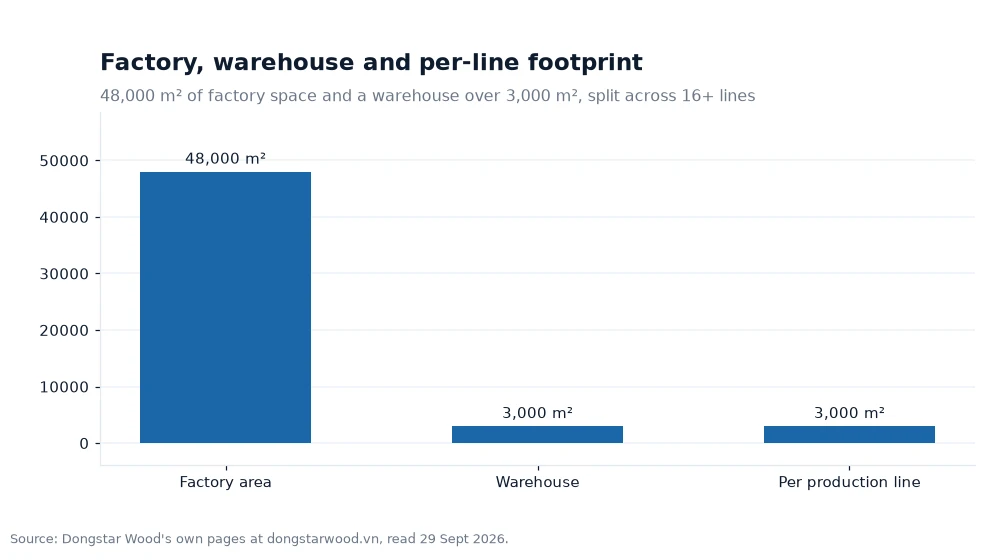
Certification is only as strong as the operation it describes, and the operation here is published in full: 48,000 m² of factory space, a warehouse of more than 3,000 m², 16+ automated production lines, a monthly supply capacity exceeding 100 × 40ft, established in 2009, in Yen Bai Province in northern Vietnam. Those figures describe an operation large enough to hold certification audits seriously, because an audit of a trading desk is a short exercise and an audit of a factory is not.
The export reach matches the footprint: clients across more than 170 countries and regions, with Europe and America named as the main markets, and a stated position of no anti-dumping tax for European and US shipments. A factory that ships to that many markets has handled the documentation routines of many customs systems, and that experience is part of what a certification claim is worth.
Reading certification claims as a buyer
The reading habit is simple: match the scheme to the question it answers, and ask for the dated certificate rather than the logo. ISO answers how the factory is managed. CE answers whether the panel can be sold as a construction product in Europe. SGS answers who tested what, and when. FSC answers where the fibre came from. BSCI answers how the factory treats its people. EUDR answers whether the consignment can be traced to its supply area. No single scheme answers all six questions, which is why the set exists.
The second habit is to verify the claim against the product. In-house lab testing from raw materials to export batch, with batch inspection items that include panel thickness consistency and core construction integrity, is the claim that a buyer can verify against a sample. A certificate that cannot be tied to a batch is a certificate that cannot be checked, and one that cannot be checked is decoration.
| Scheme | Question it answers | Document to request |
|---|---|---|
| ISO | How the factory is managed | Dated certificate for the site |
| CE / CE EN13986 | Construction product compliance | Declaration for the panel type |
| FSC | Where the fibre came from | Chain-of-custody certificate |
| EUDR | Traceability to the supply area | Due-diligence statement per batch |
| BSCI | Social compliance of the factory | Audit report for the site |
Worked example: footprint per line
Example: 48,000 m² of production space divided across 16 lines works out at 48,000 ÷ 16 = 3,000 m² per line. That is the kind of area that lets a line stay on one product family rather than switching constantly, and stable lines are what make certification audits meaningful.
Example: the capacity divides the same way. 100 × 40ft per month ÷ 4 weeks = 25 containers per week, so a certified batch that has to be held back for inspection is a small share of the week's rhythm rather than a disruption to it. Both steps are planning estimates on published figures, labelled as examples, and neither is a published specification.
Frequently asked questions
Which certifications does the Vietnamese board sector name most often?
The manufacturer lists six schemes: ISO, CE, SGS, FSC, EUDR and BSCI. Together they cover management systems, construction product compliance, testing, fibre sourcing, social audits and deforestation due diligence.
What does EUDR require from a panel shipment?
A due-diligence statement that links the consignment to its supply area. It is a traceability document, and it belongs with the CE and emission paperwork for the same batch.
How can a buyer check a certification claim?
Ask for the dated certificate itself rather than a logo, and match the scheme to the question it answers. In-house lab testing from raw materials to export batch is the claim that can be checked against a sample.
From the certificate list to a specification
A certification claim becomes useful when it is attached to a product and a batch. The commercial plywood category shows the panels the certificates apply to, and the film faced plywood category shows the formwork range with its own adhesive and emission options. With the scheme list, the product range and the batch inspection fixed, the documents that arrive with the first container are the documents that were asked for.
All quantities referenced were taken from the manufacturer's pages at dongstarwood.vn examined 29 Sept 2026[1].